Spider Solitaire - Card 2026
- 4.5
- Rating
- 100.00K
- Installs
- Free
- Price

 Analysis by App-foxy
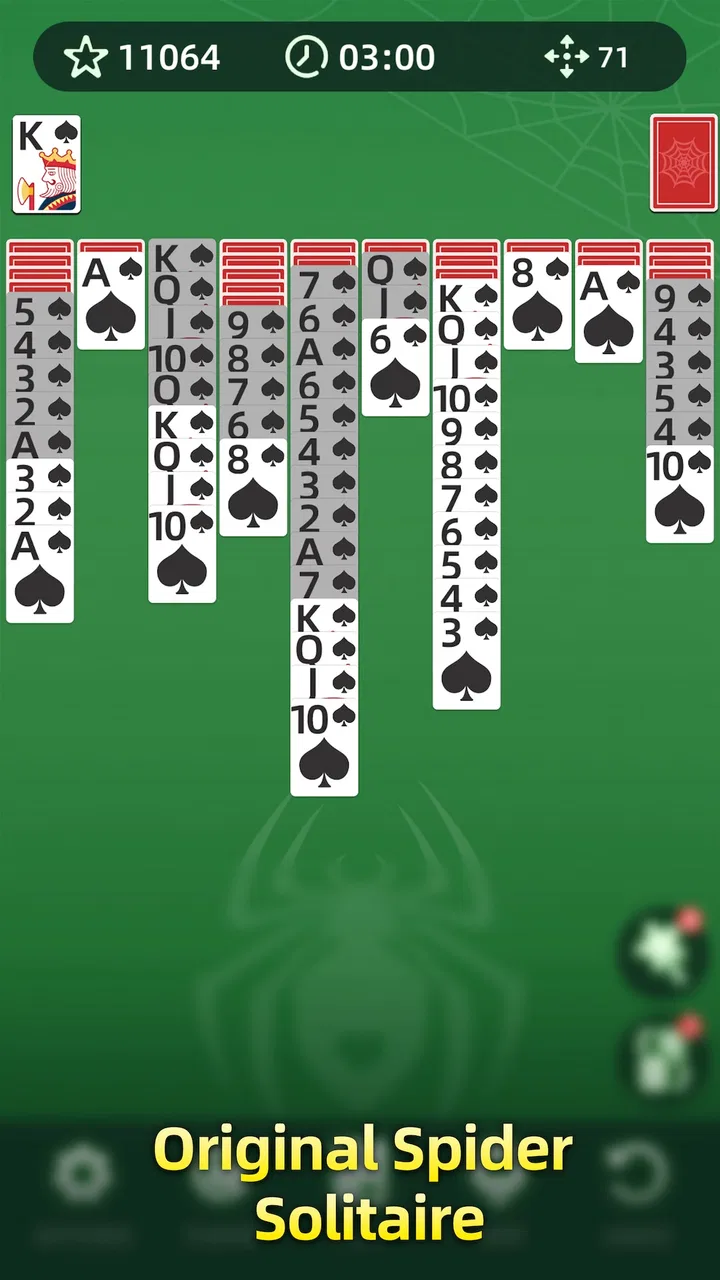
I have always liked card games that ask for attention without demanding a full evening, and Spider Solitaire - Card 2026 fits that mood well. It is a free card game from NiuAIGO built around the familiar Spider Solitaire rules, so the appeal is easy to understand: open it, arrange the cards, and work through a puzzle at your own pace. After spending time with it, I see it as a straightforward choice for short breaks, quiet concentration, and players who prefer a traditional solitaire format over a busy competitive game.
The important thing is to approach it for what it is. This is not a story-driven card adventure, a multiplayer battle, or a deck-building game with a large learning curve. Its value comes from the small decisions inside each layout: which card to move first, when to expose a hidden card, and whether a temporary stack is worth sacrificing. That simplicity makes it approachable, although players looking for constant novelty may eventually find the basic format familiar.
How the game feels during ordinary play
The best part of Spider Solitaire is the rhythm. A round can begin casually, but once several cards are exposed, I naturally start planning several moves ahead. The classic rules give every action a purpose. Moving a sequence can open a column, uncover a useful card, or create a temporary space for a more complicated rearrangement. Even when the screen looks quiet, the puzzle keeps my attention because one careless move can make the remaining layout much harder to solve.
You May Also Like

 Pandora - Music & Podcasts
Pandora’s Music Is Easy to Start, but Harder to Recover
Pandora’s strength is its low-effort path from a seed to a station. Its weak spot is how much confidence it asks you to place in connection, setup, and quiet recovery.

 8 Ball Pool
 Is Built on Rivalries, Rematches, and Routine
A close look at the rivalries, rematches, shared routines, and unanswered safety questions that turn a quick pool match into a persistent mobile community.

 Samsung Music
’s Quiet Strength Is Playing What You Already Own
Its reach comes less from spectacle than from dependable access to a personal library. That simplicity is both the app’s strongest retention engine and its ceiling.

 AccuWeather: Weather Radar
AccuWeather Review: A Quick, Clear Forecast for Everyday Decisions
For everyday plans, the best forecast is the one you can understand quickly. AccuWeather makes rain timing, radar, and local conditions easy to act on, with a few trade-offs.

 Hill Climb Racing
Why Hill Climb Racing Still Turns Crashes Into One More Run
A tiny car, a bumpy hill and one more upgrade: Hill Climb Racing keeps resurfacing because its simple chaos makes every near-miss feel personal.

 AliExpress - Shopping App
AliExpress Makes Global Shopping Feel Personal, but Shoppers Bear the Risk
AliExpress turns a global marketplace into a pocket-sized discovery engine. Its reach is useful, its shopping loop compelling, and its trade-offs easy to miss.
More From Our News Desk
View All News


The presentation is centered on smooth play rather than spectacle. That is a sensible choice for this kind of game. Card games benefit more from readable layouts and responsive interactions than from elaborate effects, and this edition keeps the focus on the table. I found that especially useful when playing for only a few minutes, because I could return to the puzzle without first learning a collection of menus or systems.
Speed expectations are also modest in a good way. A Spider Solitaire game does not need the same processing power as a 3D action title, and the simple card-table format should suit people who want something light for an older Android phone or tablet. The minimum operating system is Android 6.0, which gives the game a fairly broad range of compatible devices. That does not guarantee identical behavior on every handset, but the type of game is naturally less demanding than most modern mobile releases.
For me, the most convincing use case is a routine interruption: waiting for an appointment, sitting on a train, or taking a short break from work. I can play one layout with concentration, stop when I need to, and return later without feeling that I have abandoned a larger campaign. That makes it more practical than games that punish a short session or require a stable group of online players.
Why the classic rules still work
Spider Solitaire has a useful balance between familiarity and depth. Anyone who has played a standard solitaire variant will understand the general goal quickly, while newcomers can learn by experimenting with the columns. The challenge is not in memorizing complicated card abilities; it is in recognizing opportunities before they disappear.
One tip I would give a new player is to avoid moving every available sequence immediately. A legal move is not always a helpful move. I try to ask what the move reveals, which empty column it creates, and whether it leaves enough flexibility for cards that cannot yet be placed. This habit matters more than playing quickly, and it turns the game from simple card dragging into a small planning exercise.
Another useful approach is to treat empty columns as valuable working space rather than as a sign that the puzzle is nearly finished. An open column can let me shift a stack temporarily and expose a hidden card elsewhere. Spending that space too early can leave the layout cramped again. This is the kind of quiet tactical decision that gives the game more substance than its short description suggests.
I also recommend resisting the urge to clear a completed sequence as soon as it becomes possible if doing so would remove useful flexibility. In some layouts, the best move is the one that keeps a column available for rearrangement. That trade-off is easy to miss when playing quickly, especially during a short break, but it often determines whether the later part of a deal feels manageable or blocked.
What happens when I play repeatedly
During light use, the game’s limited scope is an advantage. There are fewer moving parts competing for attention, so the experience feels calm and predictable. I can focus on the cards instead of checking event panels, upgrading a character, or managing a collection. For a player who wants a mental reset, that restraint is more appealing than a feature-heavy alternative.
Heavy-use moments are different, not because Spider Solitaire suddenly becomes a demanding game, but because repetition exposes its boundaries. Playing several rounds in one sitting can make the familiar rules feel less varied than a larger card platform with multiple modes. If I am in the mood for changing challenges, opponents, or a stronger sense of progression, I would probably switch to another type of card game rather than expect this one format to provide endless variety.
That trade-off is worth understanding before installing it. The game is strongest when I want a focused puzzle, not when I want a broad entertainment hub. Its compact design supports quick decisions and repeated practice, but it does not replace a collection of different solitaire variants or a social card app. The right choice depends on whether consistency sounds comforting or repetitive.
One practical workflow works particularly well for me: I begin a layout with a slow scan instead of making the first obvious move. I look for cards that can uncover a hidden position, identify columns that may become empty, and keep one potential workspace in mind. Then I make the move that improves the board rather than the move that merely looks tidy. This reduces impulsive play and makes each round feel more deliberate.
Another small habit is to pause after every major rearrangement. The board can change significantly after one sequence moves, and the strongest next action may not be visible before that change. Taking a moment to rescan the columns prevents me from following an old plan after the situation has shifted. It is a simple technique, but it makes the classic rules feel more strategic without adding artificial complexity.
Stability, recovery, and everyday reliability
Reliability matters even in a small offline-style card experience. I do not want to spend a short break waiting through unnecessary screens or rebuilding my concentration after an interruption. In my use, the game’s uncomplicated format supports a dependable pick-up-and-play routine. The fewer systems involved, the less friction there is between opening the game and making the first move.
Recovery is best considered in practical terms. If I am interrupted by a message, a call, or a change of task, a solitaire round is easier to leave and revisit than a timed match. There is no social opponent waiting for my turn, and the puzzle does not require the same continuous attention as a competitive game. That makes it suitable for fragmented time, although I still prefer to finish important decisions before switching away so I remember the board clearly.
I would not describe the experience as a substitute for a guaranteed productivity break or a fully managed save system, because those expectations go beyond what this simple card format promises. Instead, I judge it by whether it lets me return to the central activity without unnecessary complication. On that measure, its narrow focus is helpful.
The current version is 1.0.8, and the game has already attracted over one hundred thousand installs. Its average rating is 4.6 from around eight hundred ratings, with roughly one hundred fifty written reviews. Those figures suggest that many players enjoy the basic experience, but I would still treat them as a sign of general reception rather than proof that every device or playing style will feel identical.
For a person deciding whether it is reliable enough for regular use, I would frame the answer this way: it is a sensible low-pressure card game when the main requirement is a familiar puzzle that starts quickly. It is less suitable if reliability means frequent content updates, competitive matchmaking, or a wide selection of modes. Those are different priorities, and a larger card app would be a better match in that case.
Device limits, cost, and who should install it
The game is free to download and is rated for Everyone, which makes it easy to recommend for households that want an uncomplicated card pastime. It also keeps the entry barrier low for someone who has never tried Spider Solitaire. The available in-app purchases range from $2.99 to $9.99 per item, so I would pay attention to the purchase prompts and decide in advance whether I want to spend anything. The core appeal should be judged by the free experience, not by assuming that optional spending is necessary.
Because this is a card game rather than a visually intensive action title, I would expect it to place relatively modest demands on compatible hardware. That is an expectation based on the game’s format, not a promise that every older device will behave the same way. Screen size can matter more than raw power: a small phone may make columns feel crowded, while a tablet can make long sequences easier to inspect. Players with limited vision may also prefer a larger display because card recognition and precise movement are central to the experience.
People using Android 6.0 or newer can consider it, but operating-system compatibility alone does not answer every practical question. Storage space, device condition, and how comfortably the cards fit on the screen all affect the experience. If a phone already struggles with basic touch input or frequently closes apps in the background, a simple card game may still be preferable to a demanding alternative, but I would not treat it as a guaranteed solution to broader device problems.
This is a good choice for someone who enjoys solitary puzzles, wants a quiet way to fill spare minutes, or likes improving through better decisions rather than unlocking stronger abilities. It also suits players who prefer a known card structure and do not want to learn a complicated economy. The game is less convincing for anyone who needs multiplayer interaction, a story, daily variety, or a strong long-term progression system.
Compared with the usual solitaire alternatives, its advantage is focus. A general solitaire collection may offer more variants, while a competitive card game can provide opponents and pressure. Those options are better if variety or social play is the priority. This game makes more sense when I want the Spider format specifically and would rather have a direct table experience than a large menu of unrelated activities.
My performance verdict after using it
My overall impression is that Spider Solitaire - Card 2026 succeeds by keeping its promise narrow. The smooth, classic card-play approach makes it approachable, and the modest nature of the game should make it a sensible fit for many compatible devices. I appreciate that a short session can still feel meaningful when I plan around hidden cards, empty columns, and future flexibility instead of simply moving whatever is available.
The limitations are equally clear. Repetition may set in for players who need constant novelty, and anyone looking for multiplayer competition or a broader solitaire package should choose a more feature-rich alternative. The in-app purchase range also means I would review each purchase prompt carefully rather than assume that free access and optional extras offer the same value to everyone.
My recommendation is simple: install it if you want a focused Spider Solitaire puzzle for quiet, flexible sessions and your device runs Android 6.0 or later. Start slowly, preserve working space, and judge each move by what it reveals rather than how quickly it clears a stack. Skip it if your idea of a card game requires opponents, changing modes, or a deep progression system. For the right player, its restraint is not a weakness; it is exactly what makes this small card game easy to return to.
FAQs for Spider Solitaire - Card 2026
01What features does Spider Solitaire - Card 2026 offer?
Spider Solitaire - Card 2026 provides a classic card game experience with a modern twist. It includes multiple difficulty levels, customizable card decks, and backgrounds. The app also offers daily challenges and achievements to keep players engaged. In addition, it has an intuitive interface designed for both beginners and seasoned players.
02Is Spider Solitaire - Card 2026 available for both Android and iOS?
Yes, Spider Solitaire - Card 2026 is available for download on both Android and iOS platforms. You can find the app in the Google Play Store for Android devices and the Apple App Store for iOS devices, ensuring a seamless experience across different smartphones and tablets.
03Does Spider Solitaire - Card 2026 require an internet connection to play?
Spider Solitaire - Card 2026 can be played offline, making it a great option for users who enjoy gaming without needing a constant internet connection. However, an internet connection is required for accessing daily challenges, leaderboards, and updates to the game.
04Are there any in-app purchases in Spider Solitaire - Card 2026?
While Spider Solitaire - Card 2026 is free to download and play, it does offer optional in-app purchases. These purchases can enhance the gaming experience by allowing players to unlock additional themes, card designs, and ad-free gameplay. However, the core game remains fully accessible without spending money.
05How can I troubleshoot issues with Spider Solitaire - Card 2026?
If you encounter issues with Spider Solitaire - Card 2026, first ensure that your app is updated to the latest version. Restarting your device can also resolve minor glitches. For persistent problems, check the app’s support page or contact customer support for further assistance. User reviews may also provide insights into common issues and solutions.
Pros
- Smooth user interface and design.
- Variety of difficulty levels available.
- Daily challenges keep gameplay fresh.
- No intrusive ads during play.
- Offline mode is available.
Cons
- Limited customization options.
- No multiplayer or social features.
- Occasional lag on older devices.
- In-app purchases can be pricey.
- Tutorial is a bit too basic.

Spider Solitaire - Card 2026
Gallery